Psychedelic Preparation: 4 Essential Skills for a Safe and Transformative Journey
Embarking on a psychedelic journey can be one of the most profound experiences of your life. But psychedelic preparation is a crucial part of whether that experience becomes meaningful—or overwhelming.
Most people focus on the substance itself. In reality, the quality of a journey is shaped far more by the skills you bring into it.
Psychedelic preparation isn’t just logistical—it’s psychological, emotional, and somatic. The more capacity you have to deeply surrender to the process, and hold whatever arises with acceptance and compassion, the more likely the experience is to lead to lasting change.
Think of the following as core psychedelic preparation skills—capacities you can develop before your journey to dramatically improve the outcome.
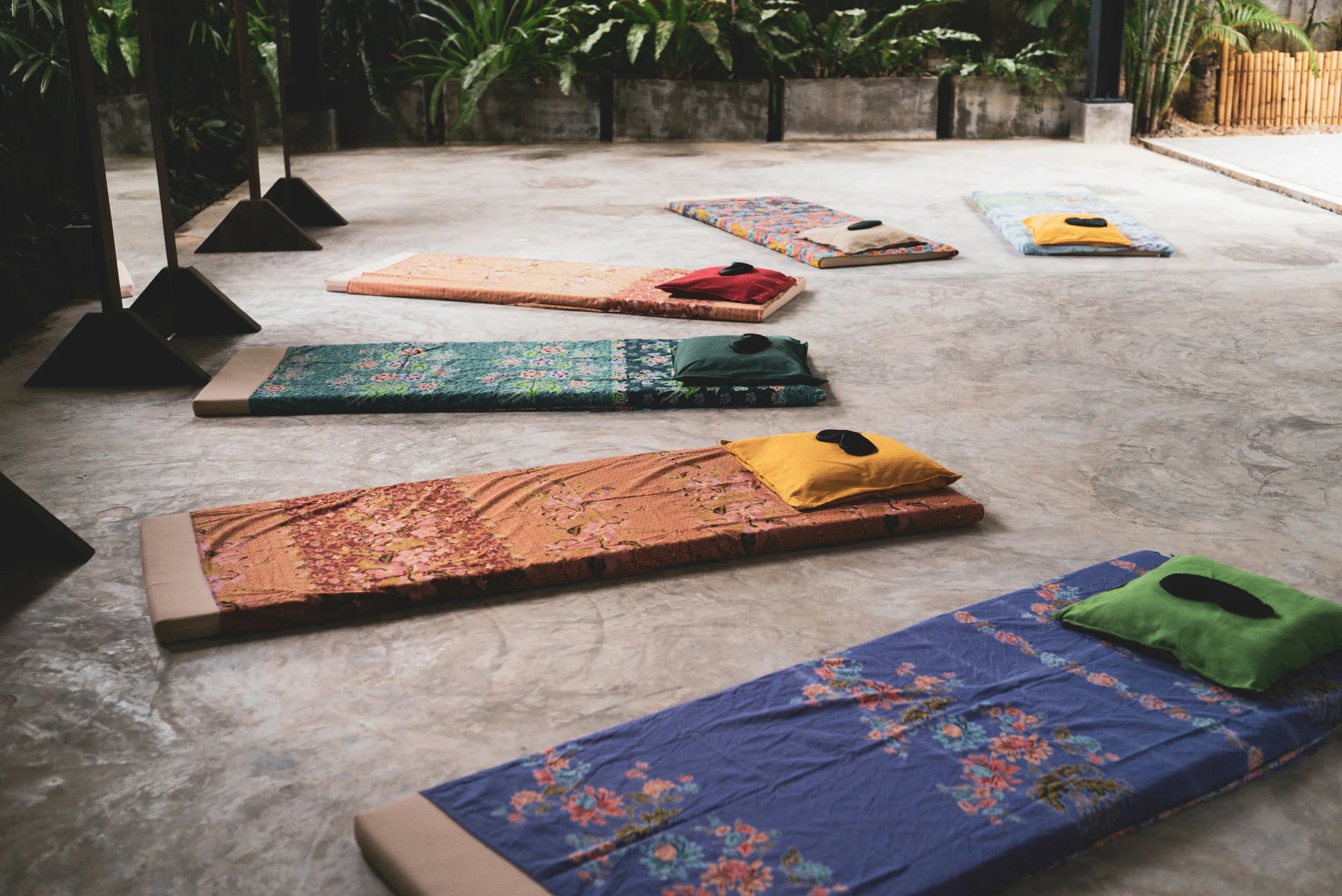
A calm, intentional space prepared for journeywork—each mat a reminder that grounding, breath, and surrender begin before the medicine does.
1) Breathwork: Regulating the Nervous System
One of the most important psychedelic preparation tools is your breath.
Breathing is unique because it’s both automatic and under conscious control. That means it becomes a direct line between your mind and your body.
Slow, deep breathing—especially long exhales—signals safety to the nervous system. During a psychedelic experience, this becomes essential. When intensity rises, your breath can help you stay grounded instead of getting pulled into panic or resistance.
Simple practice:
Inhale slowly through your nose
Exhale longer than you inhale
Relax your body at the bottom of the breath
This alone can change the trajectory of a difficult moment.
If you continue to breathe, and breathe deeply, you can move through any inner experience with more grace and ease. When on a psychedelic journey, being able to keep with your breath is an absolute game-changer.
-
Sit in a comfortable position, close your eyes, and take 3 normal breaths. Then breathe in deeply for a count of 4, hold it briefly, and breathe out slowly, through pursed lips, for a count of 6. The count doesn’t actually matter, so long as your out-breath is longer than your in-breath. Repeat this deep breathing 5 times. Watch sensations in your body and simply notice how they change.
2) Mindfulness: Learning to Stay With What Arises
Psychedelic preparation isn’t about controlling the experience—it’s about learning how to relate to it.
Mindfulness builds the ability to stay present with thoughts, emotions, and sensations without immediately reacting or trying to escape them.
This matters because difficult moments during a journey often intensify when resisted. Breathing through an experience is one thing, but if you want to deeply understand and resolve whatever is coming up, what’s crucial is the attitude you hold towards the experience. Staying with what’s happening, and finding deep acceptance for the fact that it’s happening, is key to allowing that process to unfold and resolve with minimal resistance.
Mindfulness doesn’t have to mean formal meditation. It can be practiced through:
Paying attention to your body during daily activities
Noticing thoughts without getting caught in them
Practicing non-judgment toward your internal experience
Check out this blog post to get a few ideas of how you might incorporate mindfulness more creatively.
-
Find a comfortable position and close your eyes (or come to a soft gaze). Begin by taking several deep breaths. Feel your body and the points of contact with the earth beneath you. As you breathe, scan your body and notice any sensations you find - whether it's warmth, coolness, tension, or relaxation. Notice when thoughts arise about this sensation.
Once you’ve noticed the thought, briefly say “judgment” to yourself in your head and redirect your attention back to the sensation. You can do the same thing when you notice your mind wandering to the past or the future (simply substitute ‘past’ or ‘future’).
It is important to try to be kind to yourself as you redirect your attention. Having thoughts doesn’t mean you’re doing it wrong - you are simply practicing bringing yourself back to the present.
Practice this for 5 minutes per day, then progress to 10 minutes, and so on.

Grounding through breath and mindful awareness — the first essential skill for navigating a psychedelic journey with ease and presence.
3) Somatic Awareness: Listening to the Body
A critical but often overlooked part of psychedelic preparation is learning how to track your body.
During a journey, emotions frequently show up as physical sensations—tightness in the chest, nausea, tension, or heat. These aren’t random. They often reflect deeper psychological material. We can find out what these sensations have to tell us by cultivating our capacity to simply watch them with as much compassion as we can muster.
If you’ve never practiced paying attention to your body, these sensations can feel confusing or overwhelming. Just like mindfulness, somatic awareness is a capacity you can cultivate over time. I would recommend you start just by learning to pay attention to your body and understand its cues.
Somatic awareness allows you to:
Stay with sensations instead of avoiding them
Notice subtle shifts in your nervous system
Let the body process experiences naturally
Instead of trying to “figure it out,” the work becomes feeling it through.
-
Print out a list of basic emotions: Joy, Sadness, Anger, Fear, Love, Hate, Guilt, Shame, Boredom.
Take a moment a few times a day (set a reminder) to stop whatever you’re doing, identify which emotion on this list best represents how you think you feel, and then scan your body.
Just notice what that emotion feels like. Do certain sensations stand out? Where are they? What do they look like in your mind? Are they tense, relaxed, cold, warm, dull, energetic? Just get curious.
This activity should only take a few minutes each time.
4) Parts Work: Relating to the Inner World
Another powerful psychedelic preparation practice is learning how to relate to your inner experience as parts.
Rather than seeing thoughts or emotions as problems, parts work frames them as different aspects of you—each with its own perspective and intention.
During a psychedelic journey, these parts can become more vivid and accessible. Getting skilled at navigating conversations with your parts can bring an immense amount of agency when working through something on a journey. The key is always remembering that no part has bad intentions for you, it likely just has a misguided strategy which it learned long ago. We’re all on the same team.
A simple shift:
Instead of “I feel anxious” → “A part of me feels anxious”
This creates space, curiosity, and compassion—three things that make psychedelic work far more effective.
-
Take 10 minutes each day to practice this daily parts work meditation.
Why Psychedelic Preparation Matters
There’s a growing cultural narrative that psychedelic experiences are fast, powerful, and inherently transformative.
But in practice, the most meaningful outcomes tend to come from slow, intentional preparation and integration.
Without preparation, people are more likely to:
Resist difficult experiences
Feel overwhelmed or destabilized
Miss the deeper insights available to them
With preparation, the same experience can become:
More navigable
More insightful
More likely to lead to lasting change
Preparing for a Psychedelic Journey
You don’t need to master all of these skills before your journey. Even beginning to practice one of them can make a significant difference.
Psychedelic preparation isn’t about doing it perfectly—it’s about increasing your capacity to stay present, open, and responsive to whatever arises.
If you’re looking for more personalized guidance, I offer psychedelic preparation and integration consultations where we can tailor these practices to your specific situation. I also offer trainings and workshops for clinicians on how to better prepare their clients for a psychedelic journey.
If you’re interested in working with me as a client for Psychedelic-assisted Therapy, you can book a free consultation to get started.
👉 Learn more about working with me or book a free consultation to get started.