Why Am I Turned On by This? Understanding Kink Without Pathologizing Your Desires
Sometimes sexual desire can surprise us.
You might find yourself turned on by being restrained, ordered around, watched, humiliated, praised, objectified, spanked, worshipped, dominated, or put in control. Maybe there is a particular material, body part, role, scenario, or power dynamic that reliably lights something up in you.
And then another part of you asks:
Why am I into this?
For some people, that question is mostly curiosity.
For others, there is something heavier underneath it:
What does this say about me?
Is something wrong with me?
Did something happen to make me this way?
Sexuality has a long history of being interpreted this way. Anything outside a relatively narrow idea of “normal” sex was often treated as evidence of psychological disturbance. Kink in particular has been associated with trauma, pathology, immaturity, violence, or dysfunctional relationships.
The research paints a much more complicated—and much less alarming—picture.
Kink can absolutely have psychological meaning. Our sexuality develops inside the same nervous system that contains our histories, relationships, fears, identities, memories, and longings.
But something having meaning is very different from it being a symptom.
Sometimes the more useful question is not:
“What is wrong with me that I want this?”
It is:
“What happens inside me when I imagine this?”
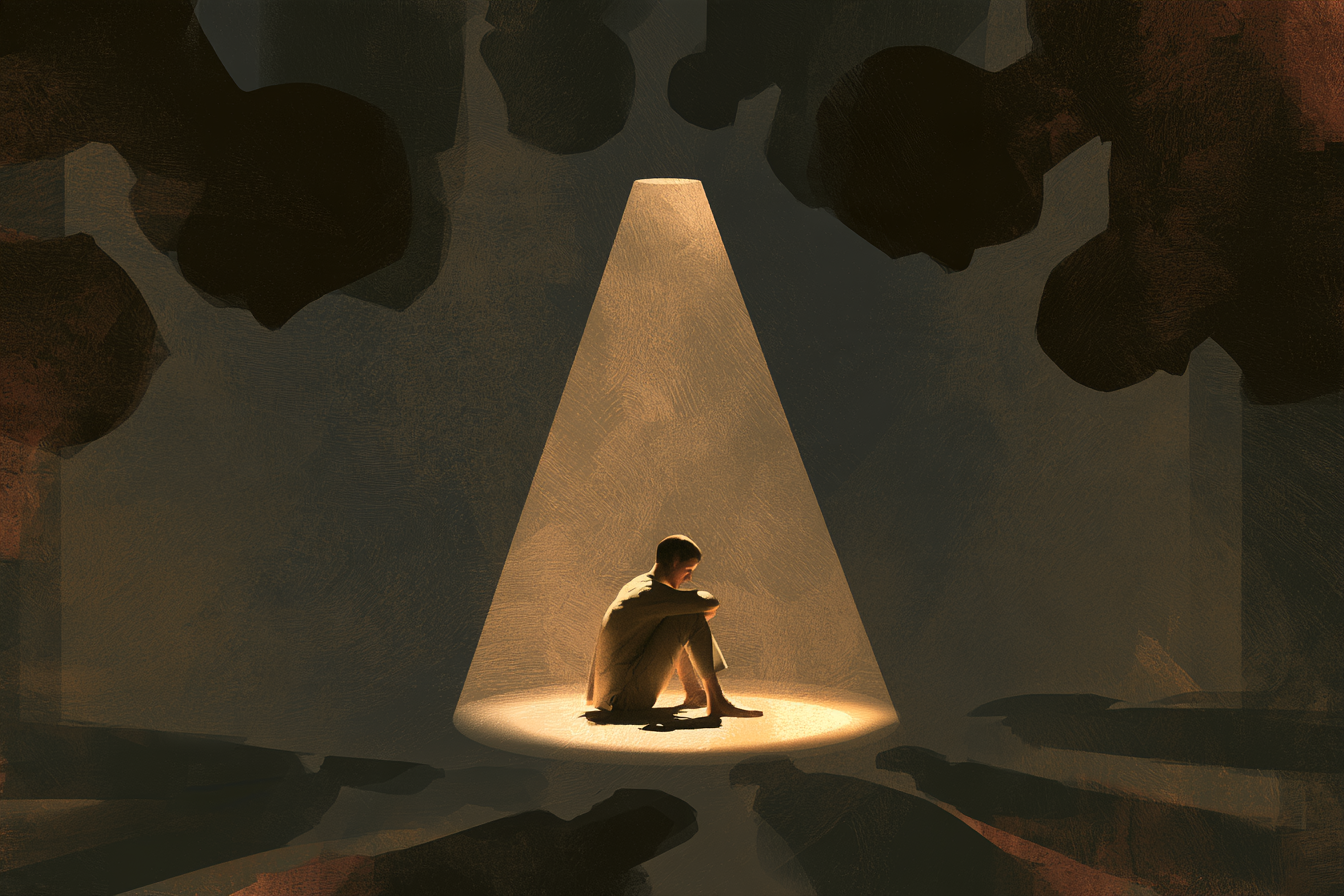
For many people, the question “Why am I turned on by this?” is shaped more by shame and judgement than by curiousity.
Kink Is Much More Common Than We Once Thought
First, it helps to broaden our definition of “normal”.
Human sexual fantasy is remarkably diverse.
In a study of 1,516 adults examining 55 different sexual fantasies, researchers found that only two met their statistical definition of “rare.” Fantasies involving both dominance and submission were common, and the researchers cautioned against assuming that a fantasy is unusual simply because it falls outside conventional sexual scripts.
Research specifically examining BDSM finds the same thing.
A representative study of 1,027 Belgian adults found that 46.8% had tried at least one BDSM-related activity, while another 22% had fantasized about one without acting on it. About one quarter described themselves as interested in BDSM.
A larger review of 60 studies found that BDSM-related fantasies appeared in roughly 40–70% of participants, while around 20% reported engaging in BDSM behavior. Just as importantly, the review found little support for older theories that primarily explained BDSM through psychopathology or psychoanalytic ideas about dysfunction.
So you might have a very specific kink.
You might have an unusual combination of desires.
But the fact that sexuality contains power, pain, restraint, roleplay, taboo, specific objects, or other unconventional themes is not especially unusual.
Human eroticism is strange. That’s what is normal.
Kink Is Not the Same Thing as a Disorder
Mental health diagnosis has also moved away from treating unusual sexual interests as inherently pathological.
The American Psychiatric Association explicitly distinguishes between an atypical sexual interest and a paraphilic disorder. According to its explanation of the DSM criteria, most people with atypical sexual interests do not have a mental disorder. Diagnosis involves factors such as significant personal distress or sexual interests and behaviors that harm - or involve people unable or unwilling to consent. Consensual atypical sexual behavior does not, by itself, constitute a mental disorder.
Research comparing kinky and non-kinky people points in a similar direction.
A large Australian population study found that BDSM participation was not associated with greater psychological distress or sexual difficulties and concluded that, for most participants, BDSM was better understood as a sexual interest or subculture than as a pathological symptom of abuse or an inability to have “normal” sex.
Another study comparing 902 BDSM practitioners with 434 controls found no evidence of poorer overall psychological functioning among the BDSM group. On several measures—including subjective wellbeing—the BDSM practitioners actually scored somewhat more favorably. That does not mean kink causes psychological health, but it does challenge the assumption that kink itself indicates psychological dysfunction.
So if pathology does not explain kink very well, what does?
The answer is: probably lots of things.
There May Not Be One Secret Origin of Your Kink
We tend to want origin stories.
Maybe it was my childhood.
Maybe it comes from my attachment style.
Maybe it was the first porn I watched.
Maybe it was some experience when I was fourteen.
Maybe it happened because of trauma.
Sometimes you really can connect an erotic interest to a particular experience.
Sometimes you can't.
Researcher Justin Lehmiller surveyed more than 4,000 Americans about their sexual fantasies and found that people attributed their favorite fantasies to many different sources: imagination, pornography or erotica, previous sexual experiences, spontaneous desires, books, media, missed opportunities—and sometimes they simply had no idea where the fantasy came from.
The scientific literature doesn't currently give us a single theory that can explain why one person develops a particular kink and another person doesn't. Reviews of BDSM research instead point toward a complicated interaction among biological, psychological, relational, social, and experiential factors.
That uncertainty is important.
Because if we begin with the assumption that every kink must have a hidden cause, we can become remarkably good at inventing psychological explanations that sound convincing but are impossible to prove.
I think it is often more useful to ask:
What does this desire do for you now?
The Act May Not Be the Most Important Part of the Fantasy
When we hear someone's kink, it is easy to focus on the most visible part.
Restraint.
Pain.
Humiliation.
Latex.
Being watched.
Giving orders.
Being ordered around.
But erotic fantasies aren't only collections of sexual activities.
They create emotional and bodily states.
Think about the difference between asking:
Why do I want someone to restrain me?
and:
What happens inside me when I imagine being unable to move?
Those questions can lead somewhere very different.
Perhaps restraint produces vulnerability.
Perhaps it allows you to stop performing.
Perhaps someone else's complete attention feels intensely intimate.
Perhaps your mind becomes unusually quiet.
Perhaps having clearly defined limits actually makes it easier to surrender.
Perhaps struggling against restraint creates a kind of embodied intensity that ordinary sex rarely reaches.
The behavior is the same.
The experience produced by the behavior may be completely different from person to person.
That distinction is central to how I think about kink in sex therapy.
Kink Can Change Your State
One reason kink can become so compelling is that intense experiences can dramatically alter attention.
During a BDSM scene, ordinary self-consciousness may become quieter. Attention can narrow toward sensation. Time can feel strange. Decisions that normally occupy your mind may temporarily disappear.
There is even some preliminary research supporting this idea.
In a very small experimental study of experienced BDSM practitioners, researchers randomly assigned participants to top or bottom roles during BDSM scenes. Topping was associated with characteristics of flow, while bottoming was associated with changes in cognitive processing as well as some dimensions of flow. Participants also reported reductions in psychological stress and negative affect after the scenes.
The study only involved 14 participants, so it should be treated as preliminary rather than definitive. But it points toward something many kinky people describe very clearly: kink can produce distinctive states of consciousness.
Sometimes the appeal isn't simply pain.
It is what pain does to attention.
Sometimes the appeal isn't simply restraint.
It is what happens when you can temporarily stop deciding what happens next.
Sometimes the appeal isn't simply dominance.
It is the extraordinary focus of having another person's body and reactions completely occupy your attention.
The act matters.
But the state it creates may matter just as much.
Power Can Be Erotic Because It Changes What Becomes Possible
Power is one of the most common themes in sexual fantasy.
But power can serve very different functions.
Submission might allow someone who carries enormous responsibility in ordinary life to stop making decisions for a while.
Being commanded might provide permission to want something they normally have difficulty allowing themselves to want.
Consensual objectification might make it possible to temporarily stop evaluating yourself and simply become a body experiencing sensation.
Dominance might create feelings of agency, competence, control, protectiveness, responsibility, or intense attentiveness.
Humiliation might create vulnerability—or take something that would ordinarily feel threatening and transform it into something chosen, bounded, and erotic.
Praise might create permission to receive attention that feels almost unbearably intimate in ordinary life.
There is no universal kink dictionary where:
“I like being restrained” = “I have this particular psychological issue.”
Two people can enjoy exactly the same sexual activity for completely different reasons.
And the same person can enjoy it for several reasons at once.
This is one place where attachment can sometimes be interesting to explore - not as an explanation that reduces kink to an attachment wound, but as another way of understanding what vulnerability, autonomy, control, closeness, or surrender mean to you.

Eroticism often feeds on contrast: safety and danger, control and surrender, strength and vulnerability, familiarity and taboo.
Sometimes the Turn-On Is the Contrast
Eroticism often feeds on contrast.
Safe people can play with danger.
Highly competent people can enjoy helplessness.
Gentle people can fantasize about aggression.
People who value equality can enjoy carefully negotiated erotic inequality.
Someone who spends all day taking care of other people may find enormous pleasure in surrender.
Someone who frequently feels powerless might enjoy becoming extraordinarily powerful within a negotiated scene.
The contradiction can actually be part of the erotic charge.
Sexual fantasy creates a peculiar psychological space where we can play with something precisely because it is different from ordinary life.
This is one reason trying to infer someone's values or personality from their fantasies can go badly.
The person who fantasizes about submission may be highly assertive outside the bedroom.
Someone who enjoys consensual degradation may have absolutely no desire to be disrespected in everyday life.
Someone who fantasizes about losing control might care deeply about consent - which may be precisely why it becomes possible to enjoy deliberately handing control to someone they trust.
Fantasy does not necessarily erase boundaries.
Sometimes clear boundaries are what make surrender possible.
Fantasy Is Not a Confession
Another important distinction is the difference between fantasy and desire.
A sexual fantasy is something your mind finds erotically compelling. That does not necessarily mean you want the fantasy reproduced literally in real life.
Sex researcher Justin Lehmiller makes this distinction explicitly: people can fantasize about scenarios they have no desire to enact, while other fantasies may represent experiences they genuinely want to try.
Fantasy gets to cheat.
It can remove consequences.
It can exaggerate.
It can make something perfectly safe.
It can create impossible bodies and scenarios.
It can make you simultaneously want and not want something.
It can transform danger into excitement because you, as the author of the fantasy, already know how the story ends.
And people fantasize for many reasons beyond rehearsing things they actually want to do. In Lehmiller's research, people reported fantasizing to experience arousal, explore curiosity, meet emotional or sexual needs, escape reality, engage taboo, relax, and feel more sexually confident, among other reasons.
So a sexual fantasy is not necessarily:
a plan,
a moral belief,
a political position,
a secret wish,
or a psychological confession.
Sometimes it is simply a remarkably effective erotic story.
Desire Can Also Learn
Sexuality is not completely fixed or hardwired.
Research on human sexual conditioning suggests that learning and association can contribute to sexual response, although this research is complicated and does not provide a simple formula for explaining how specific kinks develop.
That makes intuitive sense.
Sexuality develops through countless experiences of fantasy, masturbation, relationships, pornography, erotica, memory, imagination, anticipation, and sexual experience.
A particular image appears repeatedly when you're intensely aroused.
A certain relationship dynamic produces an extraordinary sexual experience.
A sensory cue becomes linked with anticipation.
An emotional theme gets incorporated into masturbation fantasies again and again.
Our erotic systems can learn.
But even this doesn't necessarily tell us why one thing became erotically powerful while a thousand other experiences didn't.
Sometimes the origin simply remains mysterious.
And that can be okay.
But What About Trauma?
This is where the conversation requires a little more nuance.
Can trauma influence sexuality?
Of course.
Trauma can shape our relationship to vulnerability, control, danger, attention, sensation, trust, power, intimacy, and our bodies.
Sex involves all of those things.
For some people, understanding connections between trauma and a particular kink can be deeply meaningful.
But that is completely different from saying:
“You are kinky because you were traumatized.”
The research does not support trauma as a general explanation for BDSM. A systematic scoping review of 60 studies found little overall support for psychopathological and psychoanalytic explanations of BDSM and did not find BDSM practitioners generally characterized by higher levels of mental health or relationship problems.
Lehmiller recently explored this exact question with kink educator and mental-health professional Rebecca Blanton on the Sex and Psychology Podcast, including what research actually says about the relationship between trauma, BDSM, and mental health.
I think the most useful position is to hold two possibilities at once:
Your trauma may have shaped aspects of your sexuality.
And:
Your sexuality does not need to be explained by trauma.
I've written more specifically about the places where kink and trauma do intersect here: When Kink Mirrors Trauma: How Conscious Play Leads to Healing
Shame Can Make the Question “Why?” Feel Much More Urgent
Sometimes the intense need to understand a kink isn't really curiosity.
It's a search for an explanation that will make the desire acceptable.
You might think:
If I can figure out where this came from, maybe I can decide whether I'm allowed to have it.
Or:
If it came from trauma, maybe that explains why I want something so messed up.
When shame is present, psychological exploration can quietly turn into an investigation in which your sexuality is assumed guilty until proven innocent.
This is particularly common for people who grew up with strong messages about what sexuality was supposed to look like.
If you learned that there is a narrow range of acceptable desire, discovering an unconventional turn-on can feel less like erotic curiosity and more like evidence against you.
You can absolutely explore where a desire comes from.
But you don't have to prove that it has an innocent origin before you're allowed to have it.
Instead of Asking “Why Am I Like This?” Ask “What Does This Give Me?”
If you want to understand a kink, I often recommend spending less time interpreting its imagery and more time tracking the experience itself.
Ask yourself:
What happens in my body when I imagine this?
Do you become warm? Energized? Grounded? Tense? Open? Focused? Small? Powerful? Still? Alive?
What emotional state does it create?
Permission? Vulnerability? Safety? Danger? Rebellion? Being desired? Being seen? Being cared for? Freedom from responsibility?
What happens when the power dynamic changes?
What becomes possible when you're in control?
What becomes possible when you're not?
What is actually erotic about the scenario?
The sensation?
The anticipation?
The words?
The clothing?
The vulnerability?
Being watched?
Being intensely attended to?
The power?
The surrender?
The relationship?
What would happen if one element disappeared?
Would the fantasy still be erotic without the pain?
Without the humiliation?
Without the relationship?
Without the sense of danger?
Without knowing that you could stop it?
Sometimes subtracting pieces tells you more than analyzing the fantasy as a whole.
And finally:
If I removed the sexual behavior but preserved the emotional experience, what would remain?
That question can be remarkably revealing.
When Is Kink Worth Bringing to Therapy?
Being kinky is not, by itself, a reason to go to therapy.
But your relationship with your sexuality might be something worth exploring.
Therapy may be useful if your desires generate significant shame; if trauma responses arise during sexual experiences; if sexual behavior feels compulsive or difficult to control; if you repeatedly override your own boundaries; if you and a partner struggle to navigate differences in desire; or if you simply want to understand your erotic life more deeply.
Consent and safety matter too.
Calling something kink does not automatically make it healthy. Abuse can happen within kinky relationships just as it can anywhere else. Erotic power exchange works very differently from coercion when the people involved can genuinely negotiate, communicate limits, recognize risk, withdraw consent, and trust that their boundaries will be respected.
And sometimes nothing needs fixing at all.
Sometimes therapy can simply be a place where you are allowed to explore a strange, complicated, fascinating part of yourself without someone immediately trying to diagnose it.
Your Desire Can Become Something You're Curious About
One of the strange things about sexuality is that we do not entirely choose what turns us on.
Desire often arrives before explanation.
You may eventually understand why a particular fantasy has so much power for you.
You may find connections with your history.
Your relationships.
Your nervous system.
Your attachment patterns.
Your need for intensity.
Your longing to surrender.
Your desire to feel powerful.
Your relationship with shame.
Or parts of yourself that rarely get to emerge anywhere else.
You might also never discover a satisfying origin story.
That doesn't make the desire meaningless.
And it doesn't make it pathological.
In sex therapy, I am often much less interested in asking:
“How do we get rid of this strange desire?”
than I am in asking:
What does this desire allow you to feel?
What happens in your body when you move toward it?
What becomes possible there that is difficult to access elsewhere?
From that place, kink can become something other than evidence against yourself.
It can become another way of understanding yourself.
Kink-Affirming Sex Therapy in Colorado
If you're struggling with shame about your desires, trying to understand the role kink plays in your sexuality, or working through differences in desire with a partner, therapy can offer a place to explore those questions without assuming that something about you needs to be fixed.
My approach to sex therapy is kink-affirming, trauma-informed, and grounded in curiosity about the emotional and bodily experience underneath sexual desire. Together, we can explore what your sexuality means to you, how it connects with your relationships and history, and how to build a sexual life that feels more authentic, consensual, and connected.
If you're interested in working together, you can learn more about sex therapy at Aster Psychotherapy or reach out to schedule a consultation.